
+918042755689

Currently it only shows your basic business info. Start adding relevant business details such as description, images and products or services to gain your customers attention by using Boost 360 android app / iOS App / web portal.
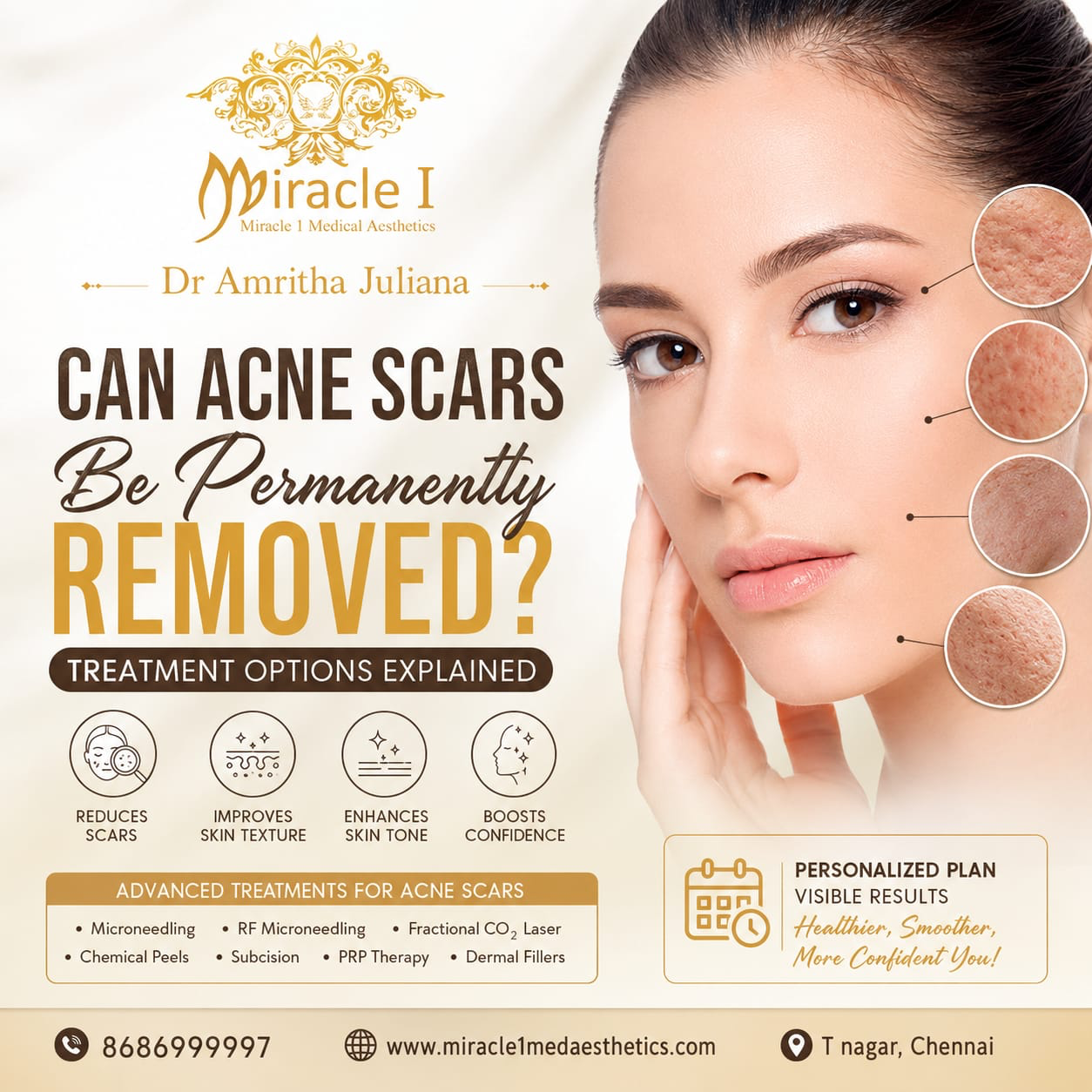
Acne may heal, but the scars it leaves behind can remain for years — affecting skin texture and confidence. One of the most common questions at Miracle1 Medical Aesthetics is: “Can acne scars be permanently removed?” According to Dr Amritha Juliana, acne scars can be significantly improved and, in many cases, become barely noticeable with the right treatment plan. The level of improvement depends on scar type, skin condition, and treatment methods. Why Do Acne Scars Form? Acne scars form when inflammation damages deeper layers of the skin. During healing, the skin may lose collagen or produce excess tissue, creating uneven texture. At Miracle1 Medical Aesthetics, Dr Amritha Juliana explains that scars are more common when: Acne is severe or cystic Pimples are picked or squeezed Treatment is delayed Inflammation lasts longer Types of Acne Scars Ice Pick Scars Deep, narrow scars that resemble tiny holes. Boxcar Scars Broad depressed scars with defined edges. Rolling Scars Wave-like depressions caused by fibrous bands beneath the skin. Post-Inflammatory Marks Red or dark marks left after acne heals. These are not true scars but can take time to fade. Can Acne Scars Be Completely Removed? Most acne scars can improve by 50–90% depending on severity. Completely poreless skin is unrealistic, but modern treatments can greatly smooth the skin and improve appearance. Dr Amritha Juliana believes combination treatments often deliver the best results rather than relying on a single procedure. Popular Acne Scar Treatments Microneedling Stimulates collagen production and improves mild to moderate scars. RF Microneedling Combines microneedling with radiofrequency energy to target deeper scars and enlarged pores. Fractional CO2 Laser A highly effective treatment that resurfaces damaged skin and boosts collagen remodeling. Chemical Peels Helpful for superficial scars, pigmentation, and uneven tone. Subcision Used mainly for rolling scars by releasing fibrous bands beneath the skin. PRP Therapy Uses growth factors from the patient’s blood to support healing and collagen formation. Dermal Fillers Can temporarily lift depressed scars for smoother-looking skin. How Many Sessions Are Needed? Acne scar treatment is gradual. Most patients may need: 3–6 sessions for moderate scars Additional sessions for deeper scars Maintenance skincare and sunscreen At Miracle1 Medical Aesthetics, Dr Amritha Juliana advises patients that collagen rebuilding takes time, so results appear progressively. Why Combination Treatments Work Better Different scars respond to different procedures: Rolling scars may need subcision + RF microneedling Deep scars may respond better to CO2 laser Pigmentation may improve with peels and skincare Customized plans usually provide more natural and balanced results. Important Things Patients Should Know According to Dr Amritha Juliana: Active acne should be controlled first Results improve gradually Sun protection is essential Early treatment often gives better outcomes Consistency matters more than instant results Final Thoughts Acne scars are more treatable today than ever before. Modern aesthetic treatments can significantly improve skin texture, reduce visible scarring, and restore smoother, healthier-looking skin. At Miracle1 Medical Aesthetics, T Nagar, Chennai, Dr Amritha Juliana focuses on personalized acne scar treatments tailored to each patient’s skin type and scar pattern.


